


A research Institution on environmental and cultural diversity studies and preservation
Address
| Headquarter Via G. Tomasi di Lampedusa 33 - 00144 Rome - Italy VAT 97859230589 |
West Africa Headquarter Avépozo - Ibokome - Front Hotel Tropicana- BP 6057 - Lomé Togo 10 Esa Ekpo Street, Odiok Itam, Off Uyo-Itu Highway, P.O.Box 1877 Uyo, Akwa-Ibom State Nigeria Burkina Faso Office 110, Rue 15.693 Ouaga 2000 Ouagadougou, BP 3379 Burkina Faso
Nigeria Office
Specializing in West Africa
INSTITUTE FOR DEVELOPMENT ECOLOGY CONSERVATION AND COOPERATION

Scrivi un titolo accattivante.
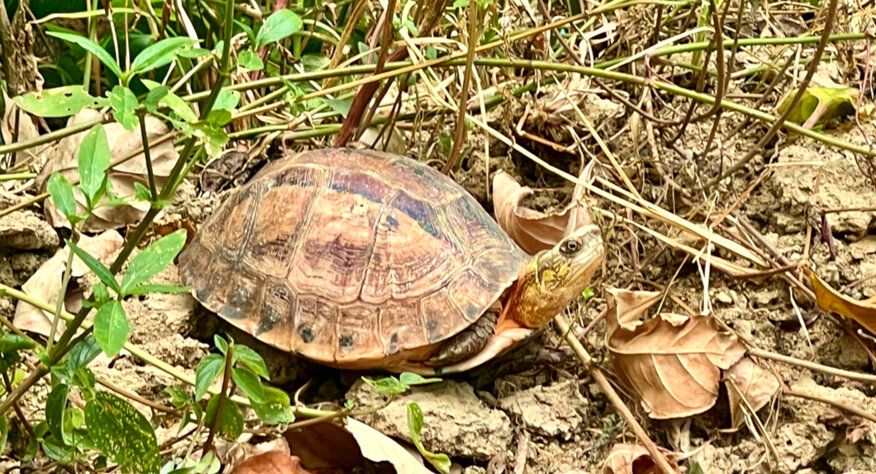
Evaluating the population size of Cuora picturata in protected and non-protected areas in Vietnam
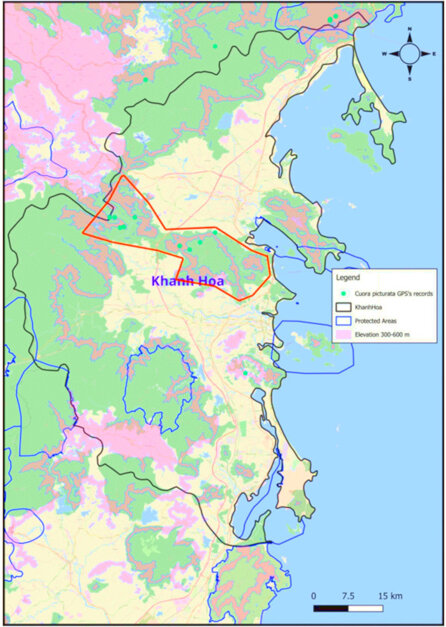
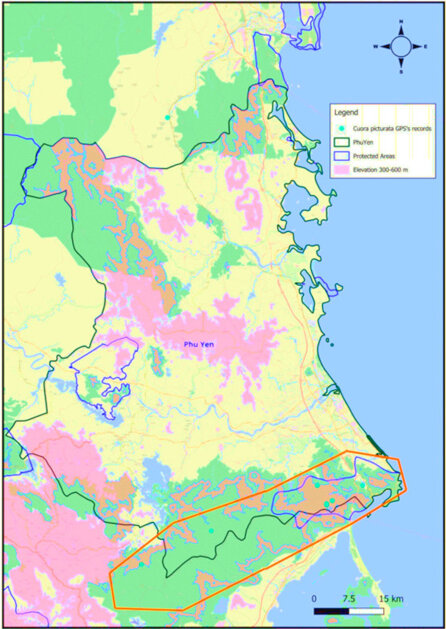

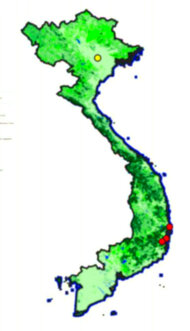
This Critically Endangered (CR; IUCN, 2025) species is restricted to south-central Vietnam, occurring in the provinces of Khanh Hoa, Phu Yen, and Ninh Thuan, and possibly also in Dak Lak (Hendrie et al., 2022). It is an endemic species to Vietnam. Confirmed records exist from the Deo Ca protected forest (Ly et al., 2011), but Cuora picturata has also been documented at a minimum of three surveyed localities in Khanh Hoa and Phu Yen Provinces, on the eastern slopes of the Langbian Plateau in southern Vietnam (Fig. 1). Its distribution is likely broader, given the near absence of comprehensive field surveys in the region. All these sites are located in broadleaf evergreen mixed with bamboo forest between 368 and 561m elevation. Estimated indigenous Area of Occupancy is 3,541 sq.km, and estimated indigenous Extent of Occurrence is 5,774 sq.km
(TTWG, 2025).
Assess the effectiveness of protected areas (PAs) in conserving Cuora picturata populations
Validate and refine conservation status assessments for Cuora picturata
Objectives
1.1 Quantify Cuora picturata population size, density, and abundance inside selected PAs.
1.2 Conduct parallel surveys in adjacent unprotected habitats to establish comparative baselines.
1.3 Evaluate differences in population metrics to determine the protective role of PAs..
Objectives
2.1 Determine whether Cuora picturata populations are consistently low inside and outside PAs (indicating high threat level).
2.2 Assess whether observed population differences can refine IUCN Red List assessments.
2.3 Identify ecological and anthropogenic drivers influencing population persistence.
Standardize a global methodology for evaluating PA effectiveness in turtle conservation
Develop evidence-based conservation and management strategies
Objectives
3.1 Provide actionable recommendations for strengthening PA management effectiveness.
3.2 Identify priority sites and habitats for future conservation actions.
3.3 Build capacity among local stakeholders for long-term monitoring of turtle populations.
Objectives
4.1 Refine field protocols for turtle surveys applicable across multiple regions.
4.2 Ensure comparability of results between sites and species.
4.3 Establish a replicable monitoring framework for chelonians in tropical ecosystems.
FIELD SURVEY
April, May, June 2026